September 1, 2026 · Case Zero · D365
The day the system lived on its own
Carlos Ocampo · Updated:
English translation of the original Spanish publication. Original dates, authorship and documentary images are preserved.
The usual signal did not arrive. In Carlos Ocampo's account, what mattered was what happened next: the community began reaching out without waiting for a central instruction.
On August 31, a signal the community expected was missing. The next day, I shared in the session what I had observed: people asking about the absence, seeking contact and responding without waiting for an instruction from me.
I presented it as a drill. My interest was not celebrating my absence, but looking at what happened to the relationships when the usual impulse did not arrive from the center.
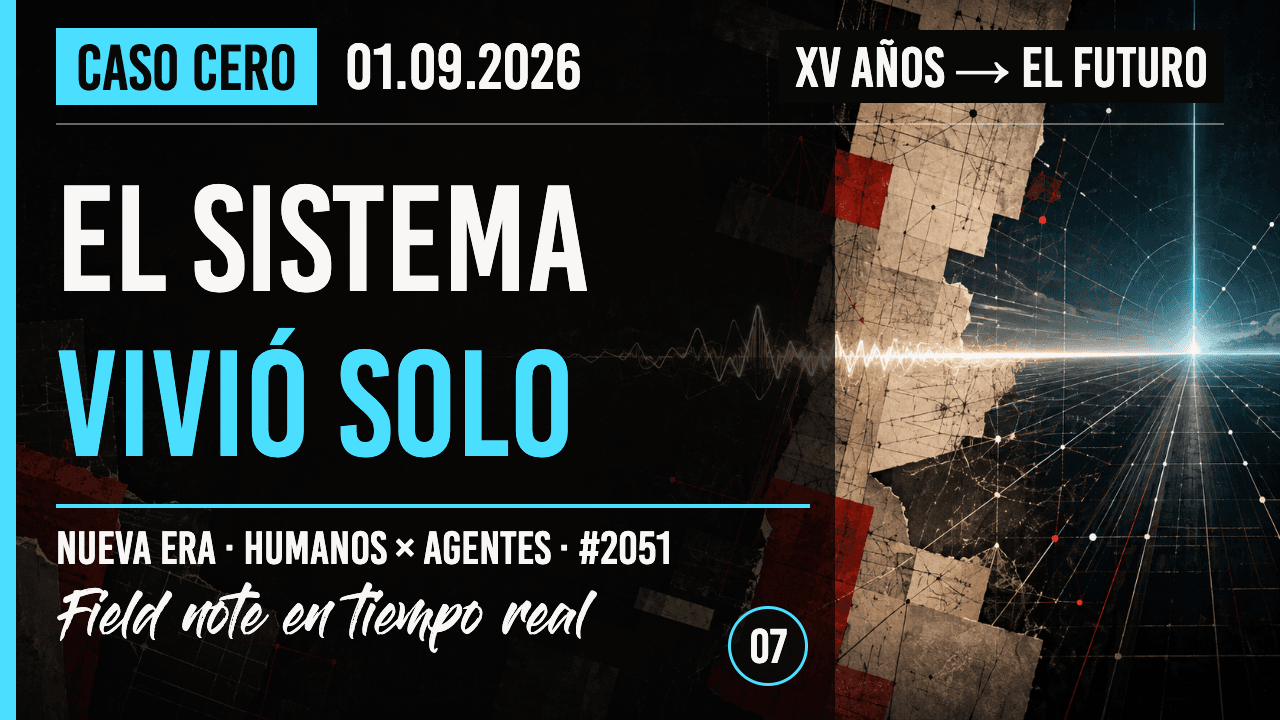
Absence also made a relationship visible
In my September 1 account, I thanked people for their reactions and attempts to connect. The missing signal had prompted other signals. My reading was that the community did not depend solely on receiving a broadcast: it could also recognize that something had changed and reach out to one another.
That is what I call Case Zero in this note. It is a field record narrated by someone participating in it. It is not an independent measurement of every exchange or proof that each member responded in the same way.
The scope matters as much as the finding. A response on one occasion does not demonstrate that a system can operate indefinitely without coordination, care or responsibility.
What I mean by autonomy
The interpretation I propose is not that the human disappears. It is to observe whether people can take initiative and maintain relationships when they do not receive the next instruction from a central figure.
In this case, the reaction I recounted was human: searching, asking, connecting. I am not describing software agents taking over leadership of the community or verified automation of all its activities.
That is why the scene connects with a thesis I had been developing in the autonomous company does not begin with AI agents. Technology is part of the conversation, but it does not replace relationships or the ability to recognize what a situation requires.
A case opens questions; it does not establish a record
The title names my interpretation of what happened. It does not claim to have demonstrated the world's first autonomous social network or a company entirely independent of its participants.
The episode makes more concrete questions possible:
- Which shared signals allow someone to detect an absence or change?
- Which relationships exist between people beyond their relationship with the person convening them?
- What capacity for initiative remains when the usual instruction does not arrive?
These questions shift attention from individual prominence to coordination. The responsibility of the person building the space does not disappear. Another responsibility becomes visible: caring for the conditions that allow others to act.
What continues after the episode
The value of Case Zero is not turning one day into a definitive conclusion. It is looking again at what happened, distinguishing the account from the available evidence and continuing to observe how relationships are sustained.
The autonomy I am trying to understand does not end when someone takes an initiative. It also needs continuity and learning. That conversation meets High Frequency Execution and protecting what sustains operations.
Source and scope
Editorial adaptation of Carlos Ocampo's record and the complete transcript of the September 1, 2026 session. The original public recording of Case Zero retains its URL. The reported observation concerns August 31; this note does not add a day number to the September 1 session.
Attendees' names and identifiable testimonials are omitted, as are figures without independent verification in the editorial record. The author's account is preserved as a field interpretation, not certification of comprehensive organizational autonomy.
Before adding another layer of technology, it helps to see how ready the organization is to decide, coordinate and execute.
Take the Organizational Self Check-Up™ →